A new Treasurer is elected at the Annual General Body Meeting. Warm applause. The outgoing officer hands over a bunch of keys and, with visible relief, walks away. It happens in Churches and organisations with quiet regularity.
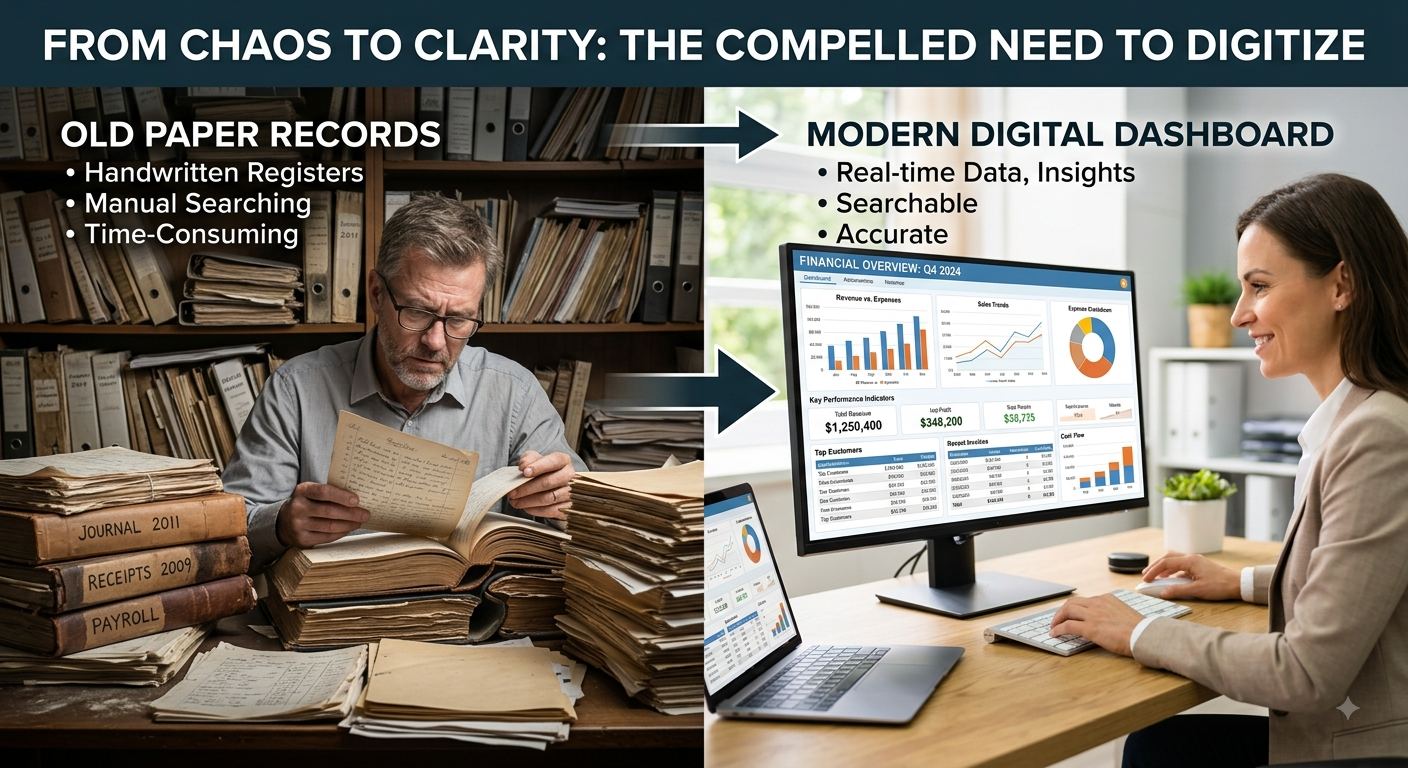
The new Treasurer finds the record room. Inside: stacks of thick ledger books going back fifteen years. Rubber-banded bundles of receipts and vouchers. A register of members last updated three years ago. A folder of bank statements with no clear system of organisation.
Somewhere in those stacks are the answers to questions the new Treasurer will face in the very next committee meeting: What is the current balance? Which members have outstanding dues? What was spent on the building renovation last year?
It will take days — maybe weeks — to find out.
This scene is not unusual. It is, in fact, the default state of thousands of organisations across Kerala. And while it has always been inconvenient, it is rapidly becoming dangerous.
What Digitization Actually Means
The word "digitization" puts many people off. It sounds expensive. Technical. Something for large corporations with IT departments, not a small parish or a residents' association.
But digitization, in its simplest form, just means this: replacing paper-based processes with structured digital systems so that your records are searchable, shareable, and safe.
It does not mean moving everything to the cloud. It does not mean subscribing to expensive software. It does not require a technical background. At its most practical, digitization for a small organisation means:
- Maintaining accounts in a digital system instead of a handwritten ledger
- Keeping a digital member directory instead of a printed register
- Storing critical records in a format that can be backed up, shared, and restored
That is it. Nothing more frightening than that.
Five Compelling Reasons You Cannot Wait Any Longer
Every time a new committee takes charge, an enormous amount of institutional knowledge walks out the door with the outgoing officers. Handwritten records are personal — they reflect the habits, abbreviations, and mental frameworks of the person who wrote them. A new Treasurer reading someone else's fifteen-year-old ledger is essentially reading a private diary in a foreign language. Digital records are structured and consistent. They do not belong to any one person. They can be understood by anyone who sits down with them.
External auditing is now mandatory for virtually every registered association, trust, and NGO in India. The days when an auditor would accept a box of handwritten registers and sign off are rapidly ending. Modern auditors expect structured printouts, Excel-compatible exports, and a clear audit trail. Organisations that cannot produce these reports face qualified audits, regulatory penalties, and — in serious cases — the loss of registration and tax exemptions that took years to earn.
Paper is extraordinarily fragile. It is vulnerable to fire, water, termites, and simple misplacement. Organisations have lost decades of records to a single flood, a leaking roof, or a careless relocation. Digital records, backed up to a USB drive, a laptop, or Google Drive, survive floods and fires. They can be restored in minutes after a device is replaced. The entire history of an organisation — every transaction, every member, every donation — can fit on a device smaller than a thumb.
Public trust in organisations — particularly religious and charitable ones — has never been under more scrutiny. Members, donors, and regulatory bodies increasingly expect financial transparency. An organisation that can produce a detailed, audited account of how every rupee was spent commands respect and continued support. One that cannot, regardless of its actual integrity, invites suspicion. Digitization is not just about efficiency. It is about accountability — the ability to demonstrate, at any moment, that the organisation is being run with complete honesty.
Younger, educated members who could contribute significantly to an organisation's administration will not take on treasurer or secretary roles if it means inheriting a system of handwritten registers. The manual ledger book is not just inefficient — it is a deterrent to the very people organisations need most. A digital system, on the other hand, is something a new volunteer can learn in an afternoon. It removes the friction that keeps capable people from stepping up.
The Barriers — And Why They No Longer Apply
A Personal Note
Over thirty years of working with financial records across organisations in the Middle East and India, I have seen the full spectrum — from organisations with immaculate digital systems to those relying entirely on ledgers that no one but the original writer could decipher.
The difference in confidence, accountability, and operational health between these two types of organisations is not subtle. It is profound.
I built Secure Ledger and Family Directory not as commercial products but as practical tools — designed specifically for the churches, temples, associations, and NGOs that have been quietly managing without the tools they deserve. They are priced to be within reach of organisations that have always assumed digital solutions were not for them.
If you are reading this as a Vicar or Trustee of a Church or President, Secretary, or Treasurer of an organization, or anyone holding an official position with a role in making final decisions—this is your moment. The tools are available, and they are cost-effective. However, if you fail to move forward by making the right decision at the right time, the potential danger could be far greater and more terrifying than we can ever imagine.
Digitization is no longer a luxury. The steadily increasing regulatory scrutiny in the financial sector, the outdated practice of maintaining paper registers, and frequent changes in office bearers or staff are major challenges small organizations face in accounting. This is becoming a critical issue that severely threatens their very existence. However, the most encouraging news is that digital solutions are now available more easily and affordably than ever before.
Ready to Make the Switch?
Explore Secure Ledger and Family Directory — purpose-built for churches, NGOs, clubs, and associations. Download free with sample data, and see the difference for yourself before spending a rupee.